
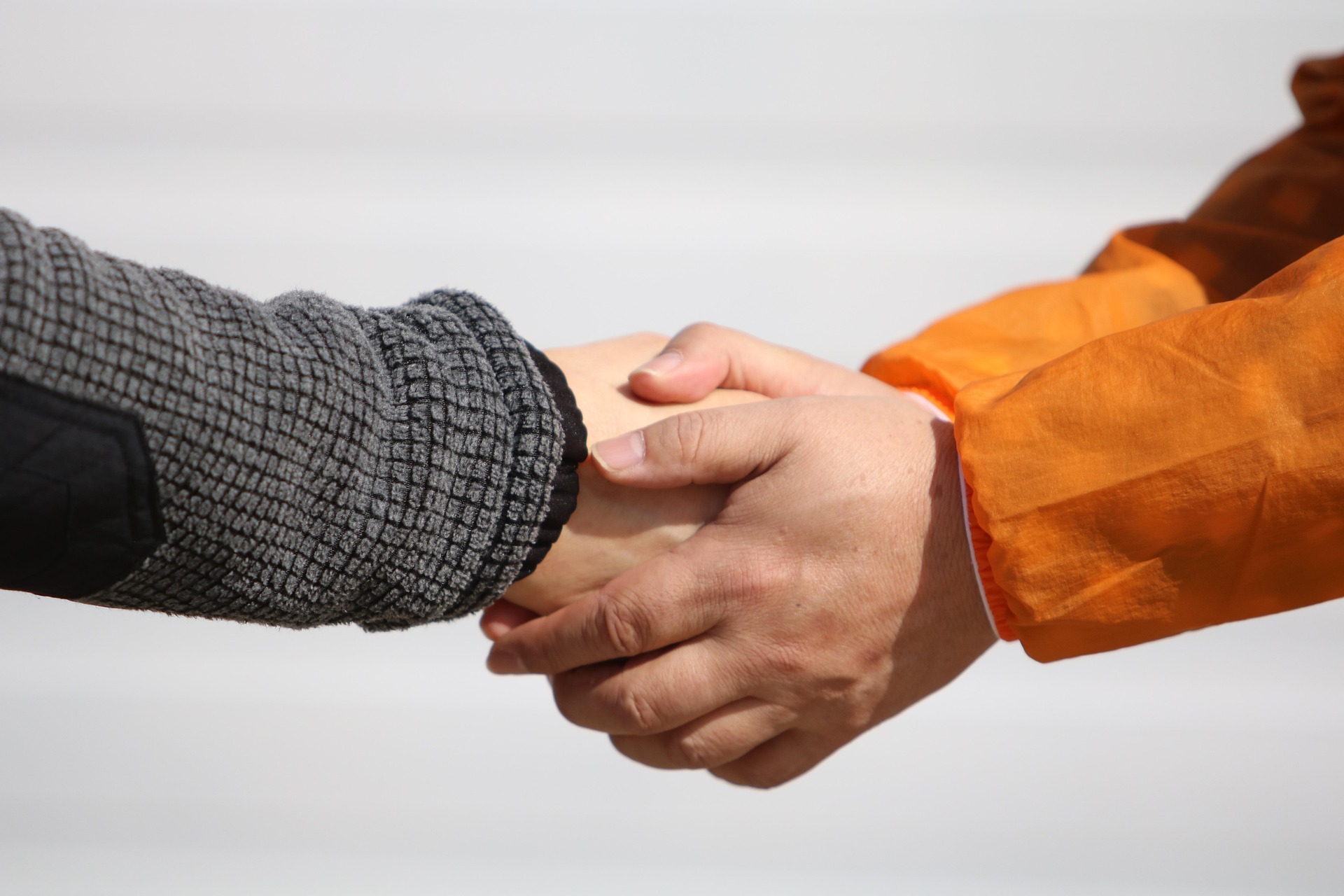
Imagine you’re negotiating the biggest deal of your life and everything seems to be going well. You confidently assume that it’s time to close the deal, and reach over to shake the other person’s hand and… they don’t shake it.
Did you misread them?
Do they have the flu?
Are they afraid of germs?
Are your hands sticky or dirty from lunch? *sneaks a look at hand*
Awkward moments like this highlight just how much meaning we attach to handshakes. And according to body language experts, not all handshakes are created equal. Research shows you can actually tell a great deal about someone’s personality from the way they shake your hand.
Types of Handshakes and What They Mean
The Sociable Shake: Extroverted people tend to have a firm handshake. Shy or neurotic people tend to have a loose handshake, almost like they are reluctant to shake your hand.
- When someone wants control right from the start, they’ll often show it in their handshake. They don’t just clasp your hand—they steer it. For example, they might keep their grip and use it to tug you toward a chair, subtly taking charge of both the greeting and the situation.
- People with a dominant streak often show it in their handshake—keeping their palm facing down while forcing the other person’s upward, the classic “submissive handshake.” Tip: If you’re dealing with a dominant hand-shaker, stick your hand out firm and straight. Don’t let your wrist twist—that way, you keep the shake on equal ground.
The Finger-Crushing Shake: An overly-firm, finger-crushing handshake might be a person’s way to establish dominance, but it can actually be a way to hide and/or compensate for a sense of weakness or ineptitude.
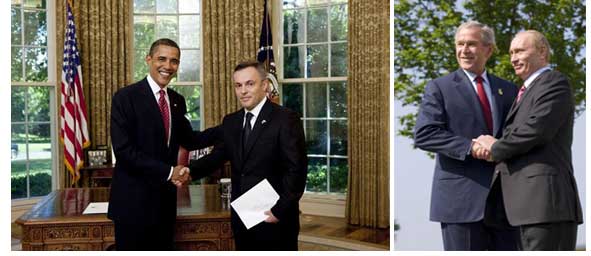
The Two-Hander Shake: This shake uses the right hand as usual, but the left hand joins in—resting on the arm or shoulder, or cupping the other person’s hand. The added hand signals honesty and sincerity, and the higher it’s placed, the stronger the attempt at closeness. (Check out the photo of former President Barack Obama below.)
Here’s the twist: you’d expect this shake among close friends or family, but it’s most often seen in politics. Leaders use it to look friendly and warm, but it often comes across as staged—a performance of camaraderie rather than the real thing.
And when the left hand cups the other person’s, it’s not just about closeness. It’s about control. You’re literally trapping the other person’s hand in yours. (Check out the photo of former President George W. Bush and Russian President Vladimir Putin below.)
The Sweaty Shake: This one’s pretty straightforward. When a person is nervous, they’re more likely to sweat, resulting in a clammy, wet handshake. There are exceptions to the rule, however. Some people are just sweat-prone.
The Finger Shake: As the name implies, this handshake involves just the fingers. While it may seem sweet and dainty, it could actually be a sign that a person wants to keep you at a distance. They’re not comfortable around you yet, and don’t want the intimacy of a full, hand-on-hand shake.
Here are some other hand gestures that can say a lot about what a person is feeling, according to body language researchers Pease & Pease (2004):
- Showing open palms (facing up) reflects your openness; showing palms down shows authority.
- Pointing at someone, especially with your palm closed, can be considered rude and aggressive.
- Steepling your fingers in front of your face reflects confidence and self-assurance.

- Standing with your hands behind your back (but with hands clasped together), is a sign of superiority, confidence, and power.
- Clenched hands, even when smiling, can indicate frustration.
So what do crossed arms say? The Peases’ research indicates that different arm gestures can reflect different emotions. For example:
- If arms are crossed and fists are clenched, a person is more likely to be feeling angry or hostile.
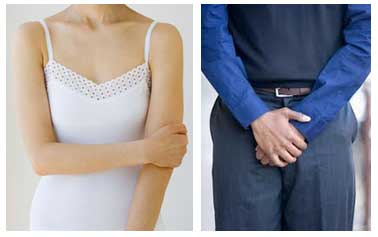
- If arms are crossed with each hand gripping the opposite arm, a person is either feeling insecure or unsure (a bad sign if you’re trying to sell them something—they’ll need some reassurance).
- If someone’s arms are crossed but their thumbs are up, they’re feeling defensive, but still cool and confident.
The Peases also indicate that when a woman has one arm down with the other crossed (and the hand gripping an arm), it’s a protective gesture. Men do the same by cupping both hands in front.
References
Dolcos, S., Sung, K., Argo, J. J., Flor-Henry, S., & Dolcos, F. (2012) The Power of a Handshake: Neural Correlates of Evaluative Judgments in Observed Social Interactions. Journal of Cognitive Neuroscience, 24(12), 2292-2305.
Kuhnke, E. (2012). Body Language For Dummies. West Sussex, England: John Wiley & Sons Inc.. Retrieved April 30, 2014 from https://www.inkling.com/read/dummies-body-language-elizabeth-kuhnke-2nd/chapter-9/analysing-handshakes
Pease, A., & Pease, B. (2004). The Definitive Book of Body Language. Australia: Pease International. Retrieved January 27, 2014 from http://e-edu.nbu.bg/pluginfile.php/331752/mod_resource/content/0/Allan_and_Barbara_Pease_-_Body_Language_The_Definitive_Book.pdf
The Guardian. (2014). The top 10 handshakes. In Guardian Jobs. Retrieved April 30, 2014, from https://jobs.theguardian.com/article/3384924/the-top-10-handshakes/
Willis, M. L., & Palermo, R. (2011). Judging Approachability on the Face of It: The Influence of Face and Body Expressions on the Perception of Approachability. Emotion, 11(3), 514-523.