
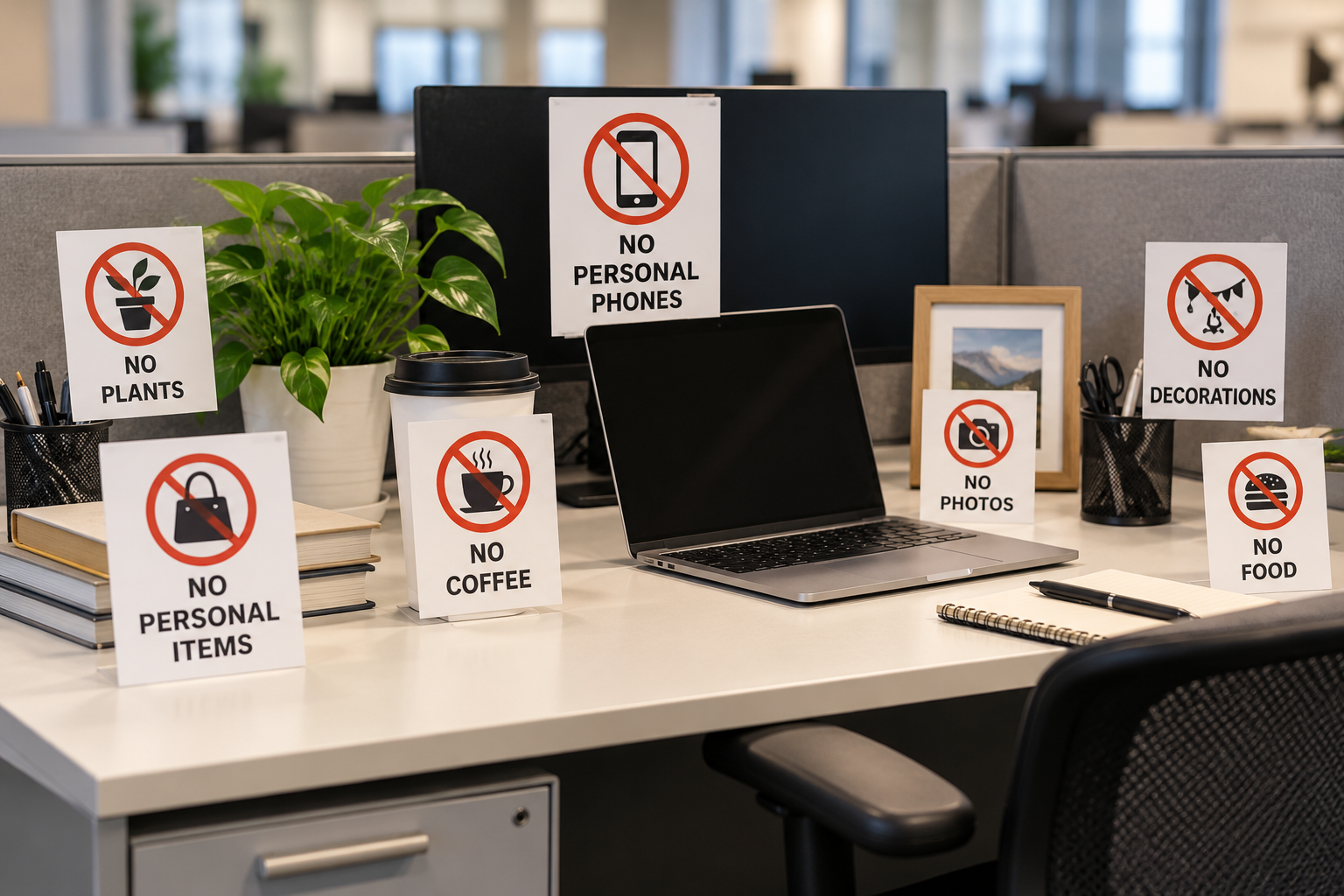
I’ve always wondered about companies that have incredibly specific rules about things that don’t seem to matter. When I worked in retail, we had to have our bags checked before leaving. Fair enough. We also weren’t allowed to wear jeans because they were unprofessional—but any other denim color was fine. What?
Other rules I’ve heard from people’s workplaces:
- You can’t have a water bottle on your desk.
- You can’t talk in the break room.
- You can’t leave five minutes early, even if you arrived fifteen minutes early.
- You can’t personalize your workspace because somehow, a small plant and a picture of your dog might make you less productive?
I’m not saying to throw out the rulebook, because some rules are absolutely necessary. You need policies to keep people safe, protect confidential information, maintain professional standards, ensure fairness, and make sure people actually do the jobs they’re being paid to do.
However, not every rule serves a useful purpose. Some are holdovers from a different era. Some were created because of one problematic employee, and now everyone has to live with the consequences. Others seem to reflect a management style that places a little too much emphasis on control or squeezing every possible minute of productivity out of the workday, often at the expense of employee well-being.
I think it’s fair to ask whether those rules are actually helping the organization or simply making employees miserable.
So let’s look at some petty workplace rules that deserve to be reconsidered.
1. Dress codes that have very little to do with the job.
Dress codes are perfectly reasonable if your uniform helps customers identify you or if a certain standard is needed when representing the company to clients. Like if you’re the head of HR and you’re interviewing me in shorts and a T-shirt with mustard stains, I’m going to rethink my career choices.
What I find odd are workplaces that insist on very specific clothing rules without being able to explain why. For example:
- Sneakers are unacceptable, even though employees spend the entire day sitting behind a computer.
- Visible tattoos are considered unprofessional, even when they have absolutely no bearing on an employee’s ability to do their job.
- A particular hairstyle or color is considered inappropriate, but nobody can explain what makes it inappropriate.
I already know what some of you are thinking—how a person looks on the outside can create a good or bad impression. However, a lot of these judgments are based entirely on assumptions. Someone has a visible tattoo, so they must be rebellious, irresponsible, or have a criminal record. Someone has brightly colored hair, so they can’t possibly be taken seriously. Meanwhile, someone in an expensive suit is automatically assumed to be competent and trustworthy. But none of these assumptions tells you anything meaningful about how well a person does their job.
2. Requiring approval for every little decision.
Imagine needing your manager’s permission to replace a broken mouse, order a $5 pack of pens, adjust the thermostat by two degrees, or get supplies from the supply closet. Some organizations have approval processes for just about everything.
I understand why financial controls and approval procedures exist. Businesses need to manage expenses and prevent employees from making decisions that could have serious consequences. But not every decision carries the same level of risk.
When employees need permission for every minor action, work slows down. Managers become bottlenecks, and capable employees begin to feel as though their judgment isn’t trusted. It also creates unnecessary work for management. Do you really want to spend half your day approving things that a responsible employee could easily handle?
3. Banning personal items from workspaces.
Some workplaces have rules against personal photographs, plants, decorations, mugs, or other small items. Why? Sometimes there are legitimate reasons—clutter, allergy triggers, or maybe even confidentiality issues. However, in an ordinary office, where none of those concerns apply, what’s the problem with a small plant or a photograph of someone’s family?
Employees spend a huge portion of their lives at work—roughly 80,000 to 90,000 hours over their lifetime, or about 40 freaking years. Having a few personal belongings around can make their workspace feel warmer and more familiar, and, frankly, less like a prison cell. Could you imagine being surrounded by three gray cubicle walls the entire day? You’d go a little cuckoo.
I’m not suggesting letting employees turn their cubicles into an amusement park with flashing lights, fog machines, and a singing fish. Reasonable limits are fine. But insisting that every desk look exactly the same seems unnecessarily rigid.
A little individuality makes a workplace more pleasant, and that’s not a bad thing.
4. Treating every glance at a personal phone like misconduct.
This is a controversial one. Some employers still treat any personal phone use as evidence that an employee isn’t working.
Now, there absolutely need to be boundaries. Employees shouldn’t spend half their shift scrolling through social media, watching videos, or texting. And in jobs involving driving, machinery, or other safety-sensitive responsibilities, phone restrictions are essential. But in an ordinary office, is checking a text really a disciplinary matter?
An employee can spend two minutes responding to a personal message or five minutes on a call and still be responsible, productive, and committed to their job. The goal should be to prevent phones from interfering with work, not to pretend employees don’t have personal lives the moment they clock in.
And if you’re a manager who takes personal calls during work hours while punishing employees who do the same, start practicing what you preach. You’re setting a double standard that’s hard to justify.
5. Requiring medical proof for every illness.
There’s something particularly unpleasant about being sick and then having to prove that you’re sick enough to deserve a day off.
You wake up with a fever, a stomach bug, or a blinding migraine. You feel awful, so you call in sick. And instead of being told to rest, you’re instructed to get a doctor’s note. So now you’re supposed to drag yourself to a clinic, possibly pay for documentation, and spend time in a waiting room when you should be recovering.
I’m not saying employers should never ask for a doctor’s note. Sometimes it’s necessary, especially for longer absences, but there’s a difference between having a reasonable policy and making employees jump through hoops every time they get sick. It may also encourage people to come to work sick because taking a day off feels like more trouble than it’s worth—and potentially getting half the office sick, too.
And really, is that what you want? An employee coughing their way through the office, distributing germs like gum because you need proof they’re sick enough?
A reasonable sick-leave policy should protect the company without treating every employee who calls in sick as a mastermind gaming the system.
6. Making employees stand when sitting would be perfectly reasonable.
This is one of my biggest pet peeves, as I’ve worked in two different fields that required standing for the entire day: retail and manufacturing. I remember witnessing a manager kick a box out from under a woman who was sitting on it because the CEO and his staff were walking through the factory. Apparently, the sight of an employee sitting down was unacceptable.
But why? I never really got a clear response. Sometimes the answer was that sitting looks lazy. Which is interesting, because sitting is apparently perfectly professional when you’re an executive, accountant, lawyer, or office manager.
There are jobs where standing and moving around are necessary. But when someone is stationed at a counter, waiting for customers, entering information, or performing another task that could be done while seated, why insist that they stand the entire time?
Prolonged standing can cause discomfort and physical fatigue. The lifers in the factory I worked at stood on cardboard to relieve the pain of standing because the company refused to invest in anti-fatigue mats. I think any employer who believes that standing creates a more attentive or professional appearance needs to start questioning their assumptions.
Would a chair actually interfere with the employee’s performance? Would it create a safety issue? Would customers receive worse service? If the answer is no, it’s time to reconsider the rule.
Before You Enforce a Rule, Ask Why It Exists
I’m not suggesting workplaces should become rule-free environments where everyone shows up whenever they feel like it, wears whatever they want, and does whatever they want. But it’s worth recognizing that some rules are shaped by assumptions about what employees should look like when they’re working, how much their behavior needs to be controlled, or how to extract the greatest amount of productivity from every minute of the workday.
Those assumptions aren’t always supported by what actually helps people work well.
So here’s what I’d encourage managers to do: periodically review your workplace policies and ask whether they’re still serving a meaningful purpose.
Are they improving safety, fairness, performance, or accountability? Are they helping employees do their jobs? Are they necessary for the type of work being performed?
And don’t forget to ask employees for their opinions. They’re the ones who experience these rules every day, so they may have useful insights into which policies help them and which ones make their jobs more difficult.
Sometimes the best way to improve the workplace isn’t to introduce another policy. It’s to get rid of one.
Sometimes managers don’t realize how restrictive their management style feels to employees. A tool like MANSSA 360 – R can help reveal whether employees feel supported and trusted, or restricted and micromanaged.