

Is creativity something we’re born with, or is it something we can develop?
The Guardian’s David Fox points to some pretty cool research from Scandinavia, Germany, and the US suggesting we may carry “creativity genes”—but whether they flourish often depends on how much imagination was encouraged growing up. (Translation: those doodles your parents stuck on the fridge might have been more important than you thought.)
Personally, I believe creativity isn’t just innate; it can be nurtured. Nowhere is this truer than in creative problem-solving—because “winging it” isn’t really a good strategy.
Relying only on what worked in the past may feel safe, but it’s not really good for progress. Innovation is a risk, but stagnation is far riskier. Just ask Kodak. Despite being the face of photography—the “Kodak moment” was practically a cultural tagline—the company missed the digital memo and clicked its way into obsolescence.
Here are some tips to add a creative jolt to your problem-solving approach:
The Problem Reversal Method
This technique starts with a simple idea: everything has an opposite. Sometimes, the best way to solve a problem is to flip it on its head.
Take morale, for example. Your team’s spirits are dragging, engagement is low, and the vibe is flat. Instead of asking, “How do we fix morale?”, ask the opposite: “What would absolutely tank morale even further?”
- Skip recognition or rewards, even after a job well done.
- Publicly criticize and belittle employees.
- Micromanage every little task.
- Destroy work-life balance with constant, obligatory overtime.
By exaggerating the “wrong” answers, you often stumble onto the right ones. Problem reversal is like creative x-ray vision—it shows you hidden angles that can spark surprisingly effective solutions.
The Free Association Method
Flexibility and open-mindedness are creativity’s secret weapons. If you “police” your own ideas too quickly—tossing them aside for being silly or illogical—you strangle the creative process before it even starts. The cure? Free association.
Here’s how it works:
- Grab a piece of paper and jot down a nagging problem you want to solve.
- Write down every idea that comes to mind—yes, even the absurd ones. (Sometimes the wackiest thought is the seed of genius.)
- Don’t censor yourself. Suspend judgment. The goal is quantity, not quality—at least at first.
Chances are, hidden in that messy brainstorm will be a handful of golden solutions. And if you do it with a group? Even better. The energy, the riffing, and the “yes, and” moments turn free association into not just problem-solving, but creative fuel.
The Ishikawa Fishbone Method
You don’t jump a whole staircase in one go—problems work the same way.
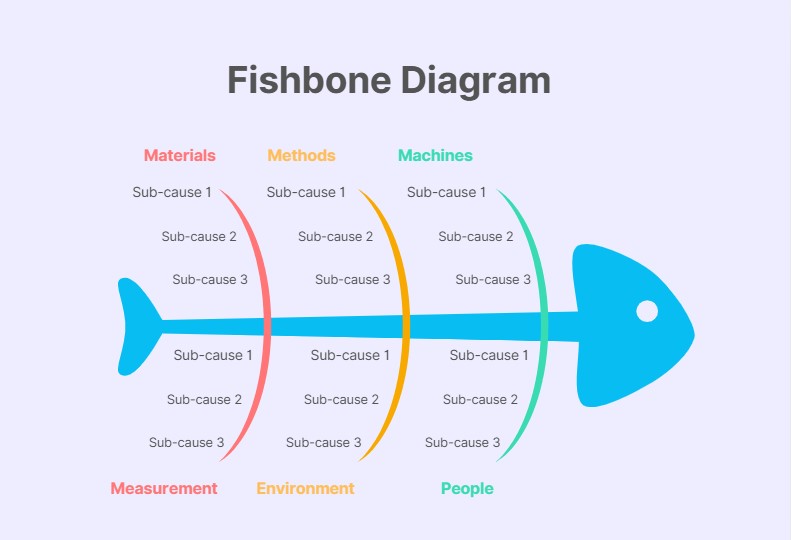
Enter the Fishbone (Ishikawa) Diagram: a simple sketch that surfaces root causes behind an issue. It looks basic, but it’s brilliant at revealing stuff you’ve been missing.
How to use it (step by step):
- Name the problem (the fish head). Write a clear, specific effect on the right (e.g., “Customer returns up 18%”).
- Draw the backbone and 4–6 major “bones.” Label them with cause categories that fit your world, like: Planning, Resources, Process/Methods, People, Tools/Tech, Materials, Environment, Policy.
- Brainstorm causes on each bone. Add sub-bones as you ask “Why?” (and then “why” again). Keep going until you hit actionable, testable causes.
- Prioritize. Circle the few causes most likely driving the problem; validate with data, then design fixes.
Here’s a quick example using a quality control problem:
- People: New hires not fully trained → inconsistent assembly step.
- Methods: No standardized SOP → variations between shifts.
- Tools/Tech: Calibration overdue → minor misalignment.
- Materials: Supplier variance week-to-week → tolerance drift.
- Environment: Humidity spikes → adhesive cure issues.
The Fishbone forces you to slow down, sort signal from noise, and fix what actually matters—one bone at a time. Less solution whack-a-mole, more root-cause sushi chef.
Want your team to do more than identify problems? Combine structured tools with coaching, and watch them build the skills to solve challenges, not just map them. Ask us about our group coaching program.
References
Cox, D. (2013, September 19). Are some people born creative? The Guardian. https://www.theguardian.com/science/blog/2013/sep/19/born-creative-study-brain-hemingway