

Question: When you’re stressed out, how tempting would it be to tell that nightmare client exactly what you think of them—complete with every colorful swear word in your vocabulary? Or to let management know exactly where they can stick those “stretch targets”?
Answer: Incredibly cathartic in theory, career-ending in practice. As satisfying as it might feel in the moment, it will most likely lead to unemployment and a reputation you don’t want. Thankfully, there are smarter, safer, and way more effective ways to blow off steam.
Here are some stress-busting exercises that actually work—no profanity required.
Exercise 1: Small Changes, Big Impact
Take a good look at your lifestyle and work approach. Is there anything you are currently doing that may be increasing your stress level? If so, try to implement some small modifications in your day-to-day habits. For example:
Eating Habits
Stressor: I skip breakfast. By mid-morning I’m “hangry” and distacted.
Small Change: Prep breakfast the night before—something quick but filling, like a sandwich.
Lifestyle Habits
Stressor: I always feel rushed in the morning. By the time I get out of bed, shower, and get dressed, it’s already time to leave.
Small Change: Set my alarm 20 minutes earlier (and maybe go to bed 20 minutes earlier too). That little shift won’t wreck my sleep, but it gives me extra breathing room so I don’t start the day in a panic.
Work Habits
Stressor: Without the pressure of a looming deadline, I procrastinate. Then I’m left scrambling at the last minute.
Small Change: Set an artificial deadline a few days before the real one. That creates a buffer for the unexpected and motivates me to start earlier instead of waiting until the eleventh hour.
Exercise 2: Know Your Triggers
Stress is a lot like a fast-growing vine: leave it unchecked, and it’ll wrap itself around everything—your focus, your work, even your relationships. The best way to stop it from taking over? Nip it in the bud by figuring out exactly what’s feeding it.
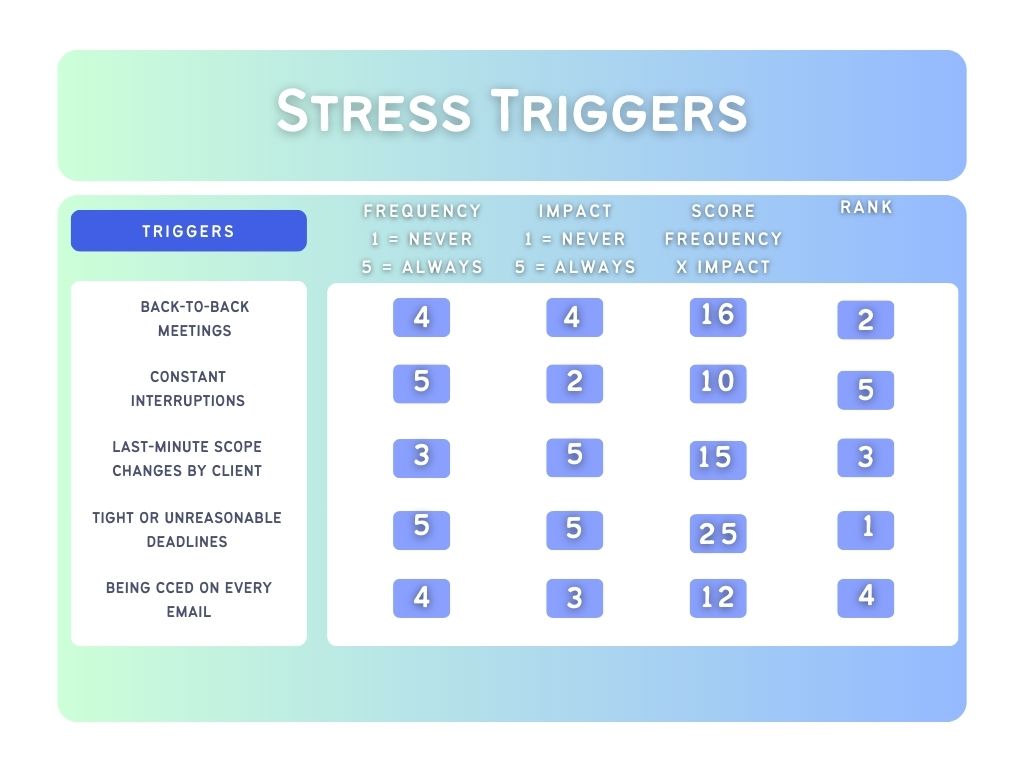
Here’s a quick exercise to uncover your top stress triggers:
- List 10 stressors at work that push your buttons. Don’t overthink it—just jot down whatever comes to mind.
- Rate each one twice:
- Frequency (1 = never, 5 = always)
- Impact (1 = no effect, 5 = huge effect)
- Multiply the two numbers to get a score.
- Rank your stressors from highest to lowest. The higher the score, the more damaging that stressor is to your well-being.
This gives you a clear picture of what’s hurting you most, so you can stop treating stress like one big tangled mess and start pulling out the worst weeds first.
Here’s an example of a table you can create for this exericse:
Exercise 3: Progressive Relaxation
Now that you’ve identified your biggest stressors, the next step is to release that tension in a way that doesn’t involve snapping at your boss or daydreaming about early retirement. One of the simplest—and most effective—tools you already have is your breath.
Deep breathing might sound basic, but it works. Why? Because slow, intentional breathing is physiologically incompatible with the adrenaline rush of stress. It signals to your body that it’s safe to relax. Best of all, you can do it anywhere—at your desk, in your car, on a bench outside, even hiding out in the bathroom.
The Deep Breathing Exercise
- Get comfortable. Sit in a relaxed position where you won’t be interrupted for a few minutes.
- Anchor your focus. Pay attention to the present—your breath, the rise and fall of your chest or diaphragm. Pick a focal point and stick with it.
- Quiet your mind. Let thoughts pass through without holding onto them. Imagine them floating by like clouds.
- Breathe deeply. Inhale through your nose for a slow count of 4. Exhale through your nose for a slow count of 4.
- Sink into it. With each breath, feel your body getting heavier, as if you’re melting into the chair.
- Stay with it. Continue this rhythm for at least 5 minutes—10 if you can.
Deep breathing is a great start, but managing stress takes more than one technique. The truth is, everyone has different ways of handling pressure—and some strategies are healthier than others. That’s where our COSA (Coping Skills Assessment) comes in.
COSA identifies how employees actually respond to stress, which strategies help them bounce back, and where they might be relying on unhealthy habits. It’s a powerful tool for:
- Employee Assistance Programs (EAPs): Helping employees get targeted support when stress is overwhelming.
- Coaching: Giving leaders and employees the insight they need to build resilience, perspective, and healthier coping patterns.
Want to help your people move from stressed to resilient? Start with COSA as part of your EAP or coaching program.